Current: Vol. 15, No. 5 (2026) 

- Development of an Adjustment Enhancement Process for Ethnic Students: A Pilot Study
-
- Surachart Putthima
- Pattra Vayachuta
- Choosak Ueangchokchai
- p27
 PDF
PDF
- Unplugged Computational Thinking in Teacher Professional Development: A Community-based Design and Implementation
-
- Muneeroh Phadung
- Ruhaisa Dearamae
- Fudailah Duemong
- p37
PDF
- Intelligent Personalized Learning Pathway Recommendation Framework for Undergraduate General Education
-
- Worrawat Thumrongvinitchai
- Suwut Tumthong
- p49
PDF
- Development of Model to Promote Media Literacy Among the Elderly by Local Administrative Organization: A Case Study of a Subdistrict Administrative Organization in Suphan Buri Province
-
- Kantima Srimaksook
- Porntida Visaetsilpanonta
- Uthithip Jiawiwatkul
- Kaysorn Sumpowthong
- p65
PDF
- Design of the System Architecture of Intelligent Supervision Support System for Vocational Dual Education
-
- Teerapong Pongton
- Suwut Tumthong
- p79
PDF
- Examining Thai Undergraduate Students’ Perceptions of Their English-Speaking Proficiency
-
- Tinutda Komol
- Somporn Chunaowarat
- p91
PDF
- The Past and the Present in the Bel Canto Technique: Historical and Physiological Considerations
-
- Linzi Tian
- Natthawat Khositditsayanan
- Chalermkit Kengkaew
- p102
PDF
- Stone Carving: The Role of Cultural Heritage in Creative Art Education and Learning in Quyang
-
- Zhancheng Yang
- Thitisak Wechkama
- Kla Sriphet
- p118
PDF
- The Development Approaches for Learner-Centered Instruction in Primary Schools
-
- Piangkae Poophayang
- Pennapa Sukserm
- Panithan Wannawan
- p137
PDF
- Community-Based Creative Art and the Negotiation of Cultural Identity: Enhancing Education Through Contemporary Art Spaces in Communities
-
- Adisak Phupa
- Arkom Sangiamvibool
- p150
PDF
- Factors Influencing Community Engagement for Health Development in Thai Communities with Migrant Workers: A Case Study in Ratchaburi Province, Thailand
-
- Nattapach Thongkam
- Porntida Visaetsilpanonta
- Uthaithip Jiawiwatkul
- Wirat Khamsrichan
- p159
PDF
- Silence in Online Learning: An Autoethnographic Reflection on Teacher Learning
-
- Anirutt Somsao
- p174
PDF
- Developing a Local Curriculum Based on Cultural Community Identity Using Soft Power Case Study of Wat Bot District Phitsanulok Province: Applications of Design-Based Research
-
- Boonsong Kuayngern
- Kamolchart Klomim
- Linda Seesang
- p199
PDF
- Developing an Integrated Leadership Model for Senior Citizen School Directors in Northern Thailand
-
- Worapoom Saengkaew
- Jomphong Mongkhonvanit
- p234
PDF
- The Development of Mathematical Problem-Solving Ability of Thai Grade 8 Students Using the Open Approach on Surface Area and Volume
-
- Sireesan Srisongmuang
- Prasert Ruannakarn
- p254
PDF
- Technology vs. Tradition: Exploring the Effectiveness of Google Translate, Natural Reader, and Traditional Approaches in English Reading Fluency
-
- Narueta Hongsa
- Pattharaporn Wathawatthana
- Chakkarin Ngoiphuthon
- p262
PDF
- Evaluating Curriculum Implementation in a Bachelor of Education Program: Toward Evidence-Based Quality Enhancement at Srinakharinwirot University
-
- Ittipaat Suwathanpornkul
- Gritthiya Narwarlaimaad
- Skol Voracharoensri
- Taviga Tungprapa
- p275
PDF
- Cultural Perception and Heritage Deconstruction of Yingzhou West Lake Based on Cultural Gene Theory
-
- Linlin Wang
- Mateta Sirisuk
- Songwit Pimpakun
- p290
PDF
- Essential Human Resource Competencies for Undergraduate Students in Human Resource Development-Related Programs in the Northern Rajabhat University Network: Perspectives From HR Professionals
-
- Ploypat Konbang
- Supharuk Aticomsuwan
- Supharsinee Numniem
- p301
PDF
- A Model of Intellectual and Moral Development Based on Buddhist Principles among Youth in Nakhon Si Thammarat Province, Thailand
-
- Tippamas Sawetvorachot
- Supattara Pusitrattanavalee
- Santi Aunjanam
- Phrametheevachirapirat Phrametheevachirapirat
- Phramaha Yothin Massuk
- p313
PDF
- Place-Based Learning Through Industrial Heritage Spaces: A Case Study of Guangzhou, China
-
- Jie Zhao
- Kla Sriphet
- p321
PDF
- Development of Administrative Strategies for the District Learning Encouragement Center in the Digital Era
-
- Pornpat Boonchan
- Chaiyuth Sirisuthi
- Prayuth Chusorn
- Bhayubhong Bhayuhah
- Wisithsak Kanchanasuwan
- p332
PDF
- Mapping Digital Entrepreneurship Competencies and Training Needs Among Local Entrepreneurs: Evidence from Chiang Rai, Thailand
-
- Sarun Nemahawan
- Panit Khemtong
- Methinee Wongwanich Rumpagaporn
- Pattarawat Jeerapattanatorn
- p367
PDF
- Promoting Creative Design Ability in Undergraduate Interior Design Students through an Interactive Learning-Design Thinking Model
-
- Yaming Yu
- Julamas Jansrisukot
- Pattawan Narjaikaew
- p381
PDF
- A Needs Assessment for Developing a Learning Management Model for Metacognitive Promotion in Pre-Service Teacher Education
-
- Oranoot Aewpradit
- Prin Tanunchaibutra
- Ariyabhorn Kuroda
- p400
PDF
- Components and Indicators of Digital Competence for Secondary School Teachers
-
- Suwaruk Suwannatrai
- Pacharawit Chansirisira
- Suwat Julsuwan
- p410
PDF
- Navigating Cultural Preservation and Educational Innovation: Administrative Strategies in the Elderly School Networks of Thailan
-
- Worapoom Saengkaew
- Phra-kru Piyawan Pipat
- Jomphong Mongkhonvanit
- p418
PDF
- Critical-Thinking Self-Confidence and Truth-Seeking as Predictors of Emotional Intelligence Among Physics Students
-
- Sam Ramaila
- Chukwuebuka Christopher Nduji
- p440
PDF
- Exploring the Use of Augmented Reality for Teaching Mathematics to Children with Autism: Insights from Focus Group Discussions
-
- Wikanda Suphasanun
- Wallapa Wassanasompong
- Vitsanu Nittayathammakul
- p454
PDF
- Digital Technology Self-Efficacy Among Second-Year Mathematics Pre-Service Teachers: A Pre-Post Intervention Study Based on PTRU Model (Professional Teacher of Rajabhat University)
-
- Phuntipa Julakarn
- Supannika Chananil
- Supachai Ratcha-Art
- p467
PDF
- Thai EFL Learners’ Attitudes Toward English Teachers’ Accents in a Northern Thai University Context
-
- Sirapatsorn Yanpetch
- Rutthaphak Huttayavilaiphan
- p475
PDF
- Integrated Development Approaches for Enhancing Participation in Highland Agricultural Development Projects in Thailand
-
- Ananya Popradit
- Weerasak Tichai
- Napaporn Singnual
- Jessadanan Wiangnon
- p487
PDF
- Proactive Operational Strategies for the Student Care and Support System based on The Seven Principles of Sappurisadhamma to Enhance Students’ Life Skills under Roi Et Primary Educational Service Area Office 2
-
- Thanawit Chitthiang
- Jiraporn Phansawang
- Suthep Moeithaisong
- p506
PDF
- A Model for Using Evaluation Results to Enhance Education Quality in Schools Managed by the Department of Learning Encouragement
-
- Noppakao Wannasiri
- Chuankid Masena
- Somruethai Taochan
- p518
PDF
- A Development Model of Leadership in the Digital Era for Basic Education School Administrators, Thailand
-
- Thoetsak Wilaikasem
- Chuankid Masena
- Narech Khantharee
- Paiwan Kotta
- Somruethai Taochan
- p529
PDF
- Video-Based Cultural Heritage Education: Disseminating the Bunu Yao Festival for Cultural Tourism
-
- Yuxuan Zhang
- Thitisak Wechkama
- Kla Sriphet
- p543
PDF
- Teacher Empowerment Model of Secondary School Administrators in Government Inspection Area 12
-
- Phiphop Kankum
- Prayuth Chusorn
- Kanokorn Somprach
- Bhayubhong Bhayuhah
- p553
PDF
- What ChatGPT Brings to Us: A Systematic Review on ChatGPT in Education
-
- Shuguang Wang
- Le Qin
- p564
PDF
- Beyond the Tutor: GenAI as a Socio-Digital Peer Learner in Teacher Education
-
- Duygu Cavusoglu
- Osman Yılmaz Kartal
- p581
PDF
- Need Assessment for Enhancing Executive Function Skills of Early Childhood Teachers under Local Administrative Organizations
-
- Kokead Peejumrus
- Tharinthorn Namwan
- Karn Ruangmontri
- p599
PDF
- Research on the Teaching Reform and Practice of the “Fundamentals of Electrical Engineering” Course Based on the OBE-BOPPPS Model
-
- Ting Wang
- Kexin Ma
- Hailin Tang
- p608
PDF
Issues
- e- Version FirstTM (Vol. 16, No. 2, 2027)
- e- Version FirstTM (Vol. 16, No. 1, 2027)
- e- Version FirstTM (Vol. 15, No. 6, 2026)
Journal Publishing Workflow
Please see the workflow for the article publication:
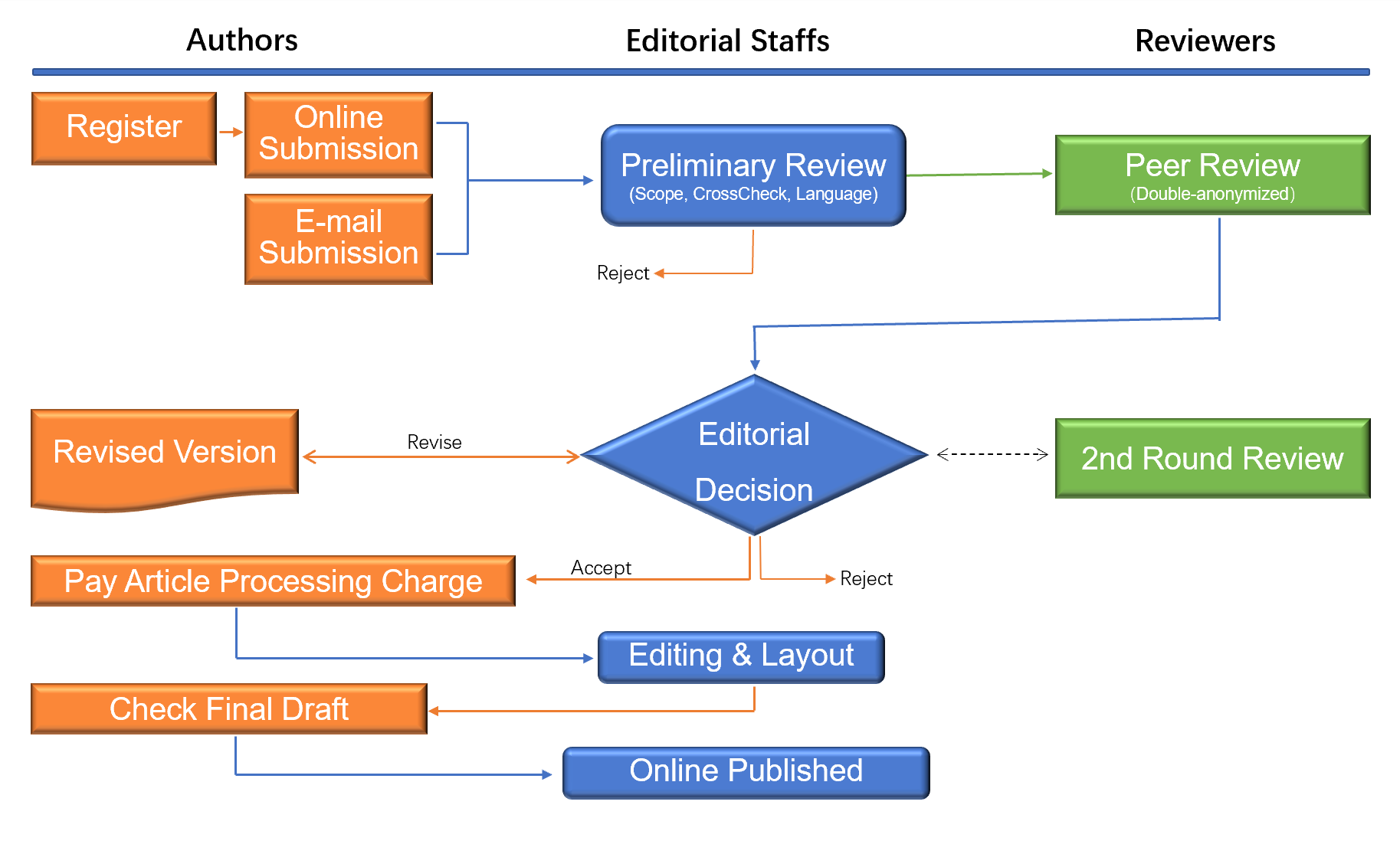
Paper Selection and Publication Process
a) Submission acknowledgement and initial screening. The journal normally acknowledges receipt of a submission within one to three working days. The editorial office conducts an initial assessment of the manuscript’s completeness, relevance to the journal’s aims and scope, originality, ethical compliance, reporting quality, and conformity with essential submission requirements. A manuscript may be returned to the authors or rejected without external review when it clearly does not meet these requirements. If another CCSE journal appears more appropriate, the editorial office may offer the authors an optional manuscript transfer. No manuscript or associated submission information will be transferred without the authors’ consent.
b) External peer review. Manuscripts that pass initial editorial screening are normally evaluated through double-anonymized peer review by at least two independent external reviewers with relevant expertise. Editorial screening is not counted as external peer review. Although the journal takes reasonable steps to protect anonymity, complete anonymity cannot be guaranteed because author identity may be inferred from preprints, citations, datasets, conference presentations, or the subject matter. The review process normally takes approximately four to ten weeks but may vary according to reviewer availability, manuscript complexity, revision requirements, and ethical or technical checks.
c) Editorial decision. Reviewer recommendations are advisory. The editor makes the editorial decision after considering the reviewers’ reports, the manuscript’s scholarly quality, relevance, originality, methodological or analytical validity, ethical compliance, reporting quality, and any other relevant information. Possible decisions include acceptance, minor revision, major revision, rejection with an invitation to submit a substantially revised manuscript as a new submission, or rejection.
d) Revision and acceptance. When revision is requested, authors must submit a revised manuscript together with a point-by-point response explaining how each comment has been addressed or why a suggested change was not made. A request for revision does not guarantee acceptance. Article processing charges are requested only after final acceptance, in accordance with the fee information published on the journal website.
e) Publication and access. Following acceptance, production, approval of the page proofs by the corresponding author, and completion of any applicable administrative requirements, the article is published online as the version of record. Published articles are made freely and immediately available under the open-access license stated in the article.
 This work is licensed under a Creative Commons Attribution 4.0 License.
- ISSN(Print): 1927-5250
- ISSN(Online): 1927-5269
- Started: 2012
- Frequency: bimonthly
Index
Contact
- Grace LinEditorial Assistant
- jel@ccsenet.org