Current: Vol. 16, No. 4 (2026) 

-
- The Hierarchical Cultivation Path of AI Literacy for Aviation Equipment Instructors under the SAMR Framework
-
- Ting Wang
- Kexin Ma
- Fuqing Zhang
- p1
 PDF
PDF
- Enhancing Pre-service Teachers’ Scientific Inquiry Questioning through Generative AI-Supported Scaffolding
-
- Pawinee Rattanakorn
- Jadsada Ratniyom
- Pattamaporn Kaewkhongkha
- p8
PDF
- Factors Influencing Vocational Students' Acceptance of Generative AI for Learning: A PLS-SEM Approach
-
- Ponpot Chooppawa
- Potsirin Limpinan
- Thada Jantakoon
- p21
PDF
- Transformational Leadership, Work Environment and Internal Marketing Enhance Organizational Effectiveness
-
- Zexiang Hu
- Khunanan Sukpasjaroen
- Aroonroj Boonkrong
- p30
PDF
- The Development of Digital Innovative Learning Media Based on the Professional Learning Community (PLC) Process for Participatory Learning
-
- Vanida Kejornrak
- Paramin Nuan-in
- Jinawatara Pakotang
- Rakpong Boonsiri
- p77
PDF
- Enhancing Knowledge, Attitudes and Practical Skills of the International Standards System for the Environmental Management (ISO14001: 2015)
-
- Anurak Luesopha
- Prayoon Wongchantra
- Likhit Junkaew
- Kannika Sookngam
- p87
PDF
- Comfort versus Legitimacy? Student Perspectives on In-Course, Online, and AI-Mediated Assessment
-
- Oleg Kirsanov
- Lovleen Kushwah
- Geethanjali Selvaretnam
- p102
PDF
- A Program to Strengthen Servant Leadership of University Library Department Heads in Nanning
-
- Xiaoying Lin
- Chaiyon Paophan
- Pattarawan Kamplae
- p116
PDF
- Understanding Technology Acceptance in Virtual Electrical and Electronics Laboratories: Evidence from Chinese Higher Vocational Students
-
- Tong Yan
- Thada Jantakoon
- Rukthin Laoha
- p128
PDF
- Predicting Teachers' Behavioral Intention to Adopt Generative AI in Teaching: An Integrated TAM-UTAUT Regression Model
-
- Xu Chengjun
- Thada Jantakoon
- Rukthin Laoha
- p146
PDF
- Industrial Engineering Students’ Acceptance of PLC Learning: A PLS-SEM Analysis Based on the Technology Acceptance Model
-
- Xiaohai Liu
- Thada Jantakoon
- Rukthin Laoha
- p165
PDF
- Who Offloads and Who Co-Creates? Comparing Undergraduate and MBA Learners in Agent-Driven Business English Project-Based Learning
-
- Jing Shi
- Chuqi Wu
- Yuting Zhang
- p185
PDF
- Happy University Administration Model of Shandong Province in the People's Republic of China
-
- Zou Lijun
- Kanchana Boonsong
- Apichat Lenanant
- Pairath Maneechote
- p212
PDF
- Organizational Learning and Organizational Innovation Performance in Vocational Colleges: The Serial Mediating Roles of Knowledge Sharing and Employee Innovation Capability
-
- Wenyan Ma
- Khunanan Sukpasjaroen
- Aroonroj Boonkrong
- p219
PDF
- Designing School-Based Positive Recreational and Digital Media Literacy Activities for Preventing Risk Behaviors among Thai Adolescents: A Qualitative Study with School Stakeholders
-
- Kanlapruk Polsorn
- Tharisara Chirasatienpon
- Chatchawan Jongkham
- Watsatree Diteeyont
- p232
PDF
- Beyond the Barrier View of Risk: Content Quality, Trust and Informed Adoption in an Extended UTAUT Model of MOOC Acceptance among Educational Personnel
-
- Phanuwat Ruangkulsap
- Thada Jantakoon
- Rukthin Laoha
- p242
PDF
- Mapping the Intellectual Structure of Virtual Reality Research in Nursing Education: A Bibliometric and Science Mapping Analysis
-
- Teeramate Jirawutthipan
- Thada Jantakoon
- Somsuk Trisupakitti
- p260
PDF
- Developing the Asset Management System for Universities in Guangxi, China
-
- Wu Xiaoxiao
- Kowat Tesaputa
- Thanyaporn Nualsing
- p277
PDF
- Instructional Management Practices and Learning Engagement of High School Students in NC II Programs: The Mediating Role of Learners’ Self-Efficacy
-
- Rose Anne O. Medina
- Kristine E. Tamayo
- p292
PDF
- Becoming an Educational Leader: A Phenomenological Exploration of Teachers’ Professional Identity and Experiences of Leadership Transition
-
- Wiralphat Wongwatkasem
- Anirudh Somsao
- Krisda Watanasak
- Chamrat Mungfaoklang
- Thanaporn Saelim
- p303
PDF
- Board-Game-Integrated Active Learning and Grade 8 Students’ Science Achievement in the Respiratory System
-
- Parichat Warin
- Benchawan Nahok
- Utain Chanlabut
- p322
PDF
- Enhancing Retention of Students Who do not Pass Early, High Risk Courses in College
-
- Joseph Opoku Gakpo
- John Dole
- Katherine McKee
- p346
PDF
- Administration of the Local Curriculum on “Durian at Ban Pa Daeng” at Ban Pa Daeng School, Kaeng Krachan District, Phetchaburi Province
-
- Grianggrai Somprasong
- Chulaporn Srirangsan
- Kanchana Boonsong
- p357
PDF
- Extending UTAUT with Metacognition and Self-Regulation: Evidence on Generative AI Use among University Students
-
- Natthawan Phoonson
- Thada Jantakoon
- Rukthin Laoha
- p369
PDF
- Designing Modular Active Learning for Vocational Chemistry: A Role-Differentiated Framework for Chinese Higher Vocational Education
-
- Ma Teng
- Low Suet Fin
- Liu Mimi
- Yu Lin
- p406
PDF
- Developing a Supervision Model by Network Partners to Develop Pre-Service Teachers through a Professional Learning Community
-
- Napasnan Narakunlanan
- Kriangsak Srisombut
- Wichit Kammantakun
- p421
PDF
- Self-Directed but Not Business-Ready: The Entrepreneurial Learning Paradox among Generation Z Communication Arts Graduates
-
- Pisit Ratanawan
- Dech-siri Nopas
- Choosak Ueangchokchai
- p435
PDF
- How Is Intellectual Property Management Taught and Assessed in Higher Education? A Focused Scoping Review of Assessment-Reporting Sources
-
- Wee Wongtiankul
- Chintana Kanjanavisut
- Pattarawat Jeerapattanatorn
- Thanapat Sripan
- p450
PDF
- The Development of Micro Game-Based Learning Model on Intelligent Metaverse Learning Environment
-
- Sorathorn Kerdnaimongkol
- Pinanta Chatwattana
- Pallop Piriyasurawong
- p480
PDF
- Implementing A Constructivism-Situated Learning Model of Chinese Pre-service Kindergarten Teachers: Observed Outcomes in Problem-solving and Collaboration Skills
-
- Yan Teng
- Julamas Jansrisukot
- Chatchai Muangpatom
- p493
PDF
Journal Publishing Workflow
Please see the workflow for the article publication:
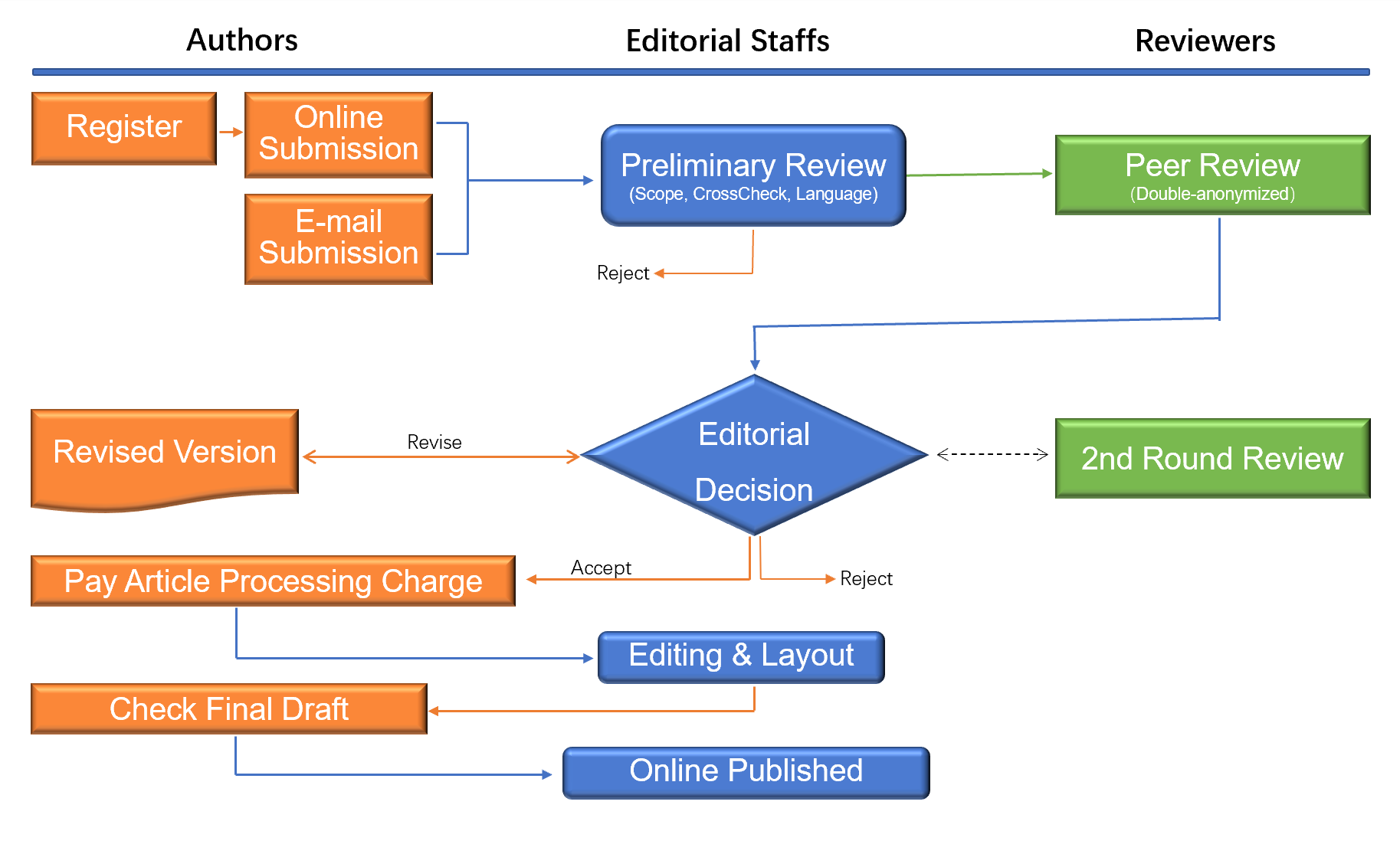
Paper Selection and Publication Process
a) Submission acknowledgement and initial screening. The journal normally acknowledges receipt of a submission within one to three working days. The editorial office conducts an initial assessment of the manuscript’s completeness, relevance to the journal’s aims and scope, originality, ethical compliance, reporting quality, and conformity with essential submission requirements. A manuscript may be returned to the authors or rejected without external review when it clearly does not meet these requirements. If another CCSE journal appears more appropriate, the editorial office may offer the authors an optional manuscript transfer. No manuscript or associated submission information will be transferred without the authors’ consent.
b) External peer review. Manuscripts that pass initial editorial screening are normally evaluated through double-anonymized peer review by at least two independent external reviewers with relevant expertise. Editorial screening is not counted as external peer review. Although the journal takes reasonable steps to protect anonymity, complete anonymity cannot be guaranteed because author identity may be inferred from preprints, citations, datasets, conference presentations, or the subject matter. The review process normally takes approximately four to ten weeks but may vary according to reviewer availability, manuscript complexity, revision requirements, and ethical or technical checks.
c) Editorial decision. Reviewer recommendations are advisory. The editor makes the editorial decision after considering the reviewers’ reports, the manuscript’s scholarly quality, relevance, originality, methodological or analytical validity, ethical compliance, reporting quality, and any other relevant information. Possible decisions include acceptance, minor revision, major revision, rejection with an invitation to submit a substantially revised manuscript as a new submission, or rejection.
d) Revision and acceptance. When revision is requested, authors must submit a revised manuscript together with a point-by-point response explaining how each comment has been addressed or why a suggested change was not made. A request for revision does not guarantee acceptance. Article processing charges are requested only after final acceptance, in accordance with the fee information published on the journal website.
e) Publication and access. Following acceptance, production, approval of the page proofs by the corresponding author, and completion of any applicable administrative requirements, the article is published online as the version of record. Published articles are made freely and immediately available under the open-access license stated in the article.
------------------------------------------------------------------------------------------------------------------------------










 This work is licensed under a Creative Commons Attribution 4.0 License.
- ISSN(Print): 1925-4741
- ISSN(Online): 1925-475X
- Started: 2011
- Frequency: quarterly
Index
Contact
- Sherry LinEditorial Assistant
- hes@ccsenet.org