Announcements
-
Applied Physics Research: Call for Papers
Posted on Aug 21, 2026 Applied Physics Research (APR) is seeking submissions for Vol. 19, No. 1, April 2027 issue. Submission deadline: March 10, 2027. Read More
Current: Vol. 18, No. 1 (2026) 

-
- The Electric Field Equations in General Relativity
-
- Frank Rafie
- p1
 PDF
PDF
- Exchangeability, Si! Entanglement, No!
-
- Frank Lad
- p16
PDF
- From Four Codons to Three Codons in the Genetic Code
-
- N. Nieto-Mar´ın
- J. A. Nieto
- p26
PDF
- A Dynamical Origin of Wave-Particle Duality From Stochastic Mass-Energy Interconversion
-
- Rudolph Elliot Willis
- p67
PDF
- Quantum Space Foam Dynamics and the Emergence of Galactic Dark Matter Halos
-
- Arunvel Thangamani
- p76
PDF
- Majorana Spinor (SM) or Neutrino (v) or Neutral Electron (e°): SM ≡ v ≡ e°
-
- Antonio Puccini
- p85
PDF
- Unbound Low-Energy Nucleons as Semiclassical Quantum Networks
-
- Steven Verrall
- Kelly S. Verrall
- Isaac Ozolins
- Pearl Scallon
- Emily Friederick
- Andrew Otto
- Kori N. Verrall
- David Wang
- Andrew Kaminsky
- Ivan Ngian
- Reagen McCormick
- Seth Schaffer
- Stephanie San Juan
- p127
PDF
- The Reason Which There Can Be Electron in the Atom Stably
-
- Koji Ichidayama
- p175
PDF
- The Concept of MOND in Space Theory
-
- Radjakoumar Thaiman
- Prakash R.
- Padmapriya D.
- Umamaheswaran K.
- p186
PDF
- Temporal Distribution of EPBs Occurrence Using Seven West African GPS Stations
-
- Estelle V. Tapsoba
- Rolland Fleury
- Emmanuel W. Sawadogo
- Allain D. Gnabahou
- Frederic Ouattara
- p216
PDF
- Analysis of Interplanetary Structures Driving Intense Geomagnetic Storms (Minimum Dst ≤ -100 nT) of Types IB and IIB During the Period 1996–2024
-
- Younoussa DIAKITE
- Christian ZOUNDI
- M’Bi KABORE
- Jean Louis ZERBO
- p233
PDF
- The Two 3d Realities of the Universe
-
- Simon Rivera
- p251
PDF
- Modified Gravitational Field of a Charged Non-Rotating Mass
-
- Frank Rafie
- p256
PDF
- Unified Dark Energy and Dark Matter: Space, the Energy Continuum With Self-compression
-
- Arunvel Thangamani
- p278
PDF
- An Operational Causal-Symmetry Framework for Quantum Nonlocality and Information
-
- Elias Rubenstein
- p287
PDF
- By Using Calculated Mass Spectrum to Probe Quantum Energy Levels in Particle Hierarchies
-
- Hung-Te Henry Su
- Po-Han Lee
- Chih-Hsueh Lin
- p305
PDF
Journal Publishing Workflow
Please see the workflow for article publication:
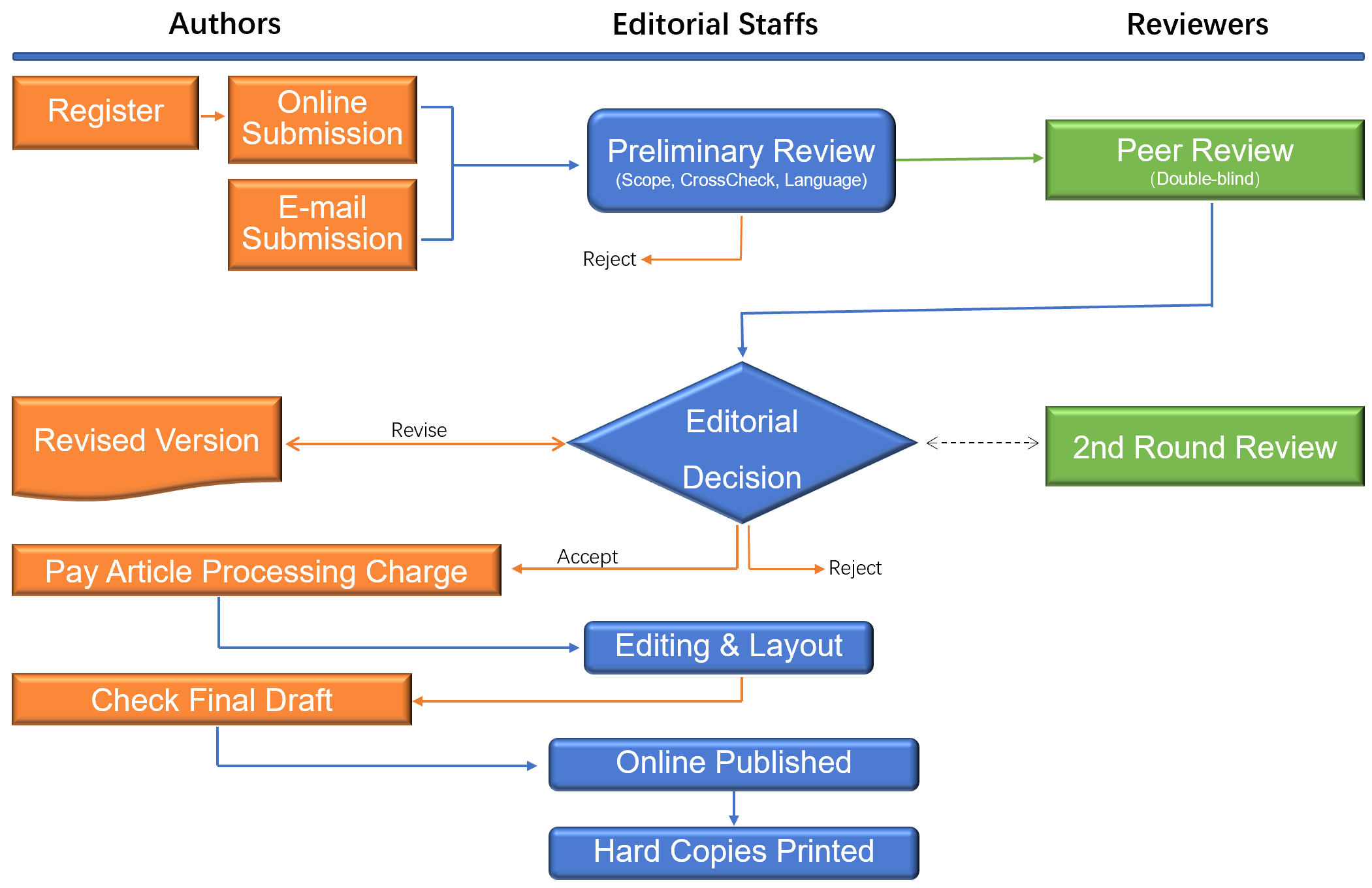
Paper Selection and Publication Process
a) Submission acknowledgement and initial screening. The journal normally acknowledges receipt of a submission within one to three working days. The editorial office conducts an initial assessment of the manuscript’s completeness, relevance to the journal’s aims and scope, originality, ethical compliance, reporting quality, and conformity with essential submission requirements. A manuscript may be returned to the authors or rejected without external review when it clearly does not meet these requirements. If another CCSE journal appears more appropriate, the editorial office may offer the authors an optional manuscript transfer. No manuscript or associated submission information will be transferred without the authors’ consent.
b) External peer review. Manuscripts that pass initial editorial screening are normally evaluated through double-anonymized peer review by at least two independent external reviewers with relevant expertise. Editorial screening is not counted as external peer review. Although the journal takes reasonable steps to protect anonymity, complete anonymity cannot be guaranteed because author identity may be inferred from preprints, citations, datasets, conference presentations, or the subject matter. The review process normally takes approximately four to ten weeks but may vary according to reviewer availability, manuscript complexity, revision requirements, and ethical or technical checks.
c) Editorial decision. Reviewer recommendations are advisory. The editor makes the editorial decision after considering the reviewers’ reports, the manuscript’s scholarly quality, relevance, originality, methodological or analytical validity, ethical compliance, reporting quality, and any other relevant information. Possible decisions include acceptance, minor revision, major revision, rejection with an invitation to submit a substantially revised manuscript as a new submission, or rejection.
d) Revision and acceptance. When revision is requested, authors must submit a revised manuscript together with a point-by-point response explaining how each comment has been addressed or why a suggested change was not made. A request for revision does not guarantee acceptance. Article processing charges are requested only after final acceptance, in accordance with the fee information published on the journal website.
e) Publication and access. Following acceptance, production, approval of the page proofs by the corresponding author, and completion of any applicable administrative requirements, the article is published online as the version of record. Published articles are made freely and immediately available under the open-access license stated in the article.
--------------------------------------------------------------------------------------------------------------------------------
NOTE:
The publisher and journal have a policy of "Zero Tolerance for Plagiarism". We check the plagiarism issue through two methods: reviewer check and plagiarism prevention tool (ithenticate.com).
All submissions will be checked by iThenticate before being sent to reviewers.
 This work is licensed under a Creative Commons Attribution 4.0 License.
- ISSN(Print): 1916-9639
- ISSN(Online): 1916-9647
- Started: 2009
- Frequency: semiannual
Index
- BASE (Bielefeld Academic Search Engine)
- Berkeley Library
- CAS (American Chemical Society)
- Civil Engineering Abstracts
- CNKI Scholar
- CrossRef
- Excellence in Research for Australia (ERA)
- Google Scholar
- Library and Archives Canada(LAC)
- LOCKSS
- Mendeley
- NewJour
- Norwegian Centre for Research Data (NSD)
- Open J-Gate
- Open policy finder
- PKP Open Archives Harvester
- Semantic Scholar
- Southwest-German Union Catalogue
- Ulrich's
- Universe Digital Library
- WorldCat
Contact
- William ChenEditorial Assistant
- apr@ccsenet.org